Crisis and Resilience Fund guidance for councils: A practical delivery guide

Deven Ghelani Published on 20th January 2026

The Department for Work and Pensions (DWP) has published detailed new guidance on the Crisis and Resilience Fund (CRF), a significant reform of local welfare support.
It signals a clear shift in national policy, away from short term crisis firefighting and towards building long term financial resilience in low income households.
The CRF is not just another hardship fund. It is a tool for councils to stabilise people’s lives, reduce repeat crises and build stronger local safety nets if implemented strategically.
This blog provides Crisis and Resilience Fund guidance for councils, setting out how local authorities and their partners can deliver crisis support while investing in resilience services.
Policy in Practice worked with Trussell to advise DWP on the design of the CRF.

Join our free webinar on Wednesday 21 January where we discuss the new fund with DWP and Trussell guest speakers. You will also hear from Zoe Sydenham, Plymouth City Council, about their practical work delivering discretionary funding to residents
From crisis response to resilience building
The CRF has two linked purposes. It exists to help people deal with an immediate financial shock and to prevent future crises by improving financial resilience.
This is where the fund is fundamentally different from previous schemes. Councils are encouraged to invest in resilience services, not just emergency payments. That means using CRF funding to reduce repeat applications, help people maximise income, stabilise housing and connect residents to the right local support at the right time.
Emergency help still matters, but it must sit inside a wider system that stops people falling back into crisis again and again.
Outcomes councils are expected to achieve
DWP guidance sets out three clear priorities for how the CRF should be used.
First, councils must provide effective crisis support, including help with essential living costs and shortfalls in housing costs when people cannot meet their basic needs.
Second, councils should invest in improving financial resilience. This includes funding services that prevent crises from occurring, recurring or escalating, and that help people stabilise their income, reduce debt and improve financial security.
Third, the CRF should be used to build a strong, joined up local support system. Councils are encouraged to create visible local safety nets with clear referral pathways between local authorities and their partners. The fund should act as the front door into wider support, not sit in isolation.
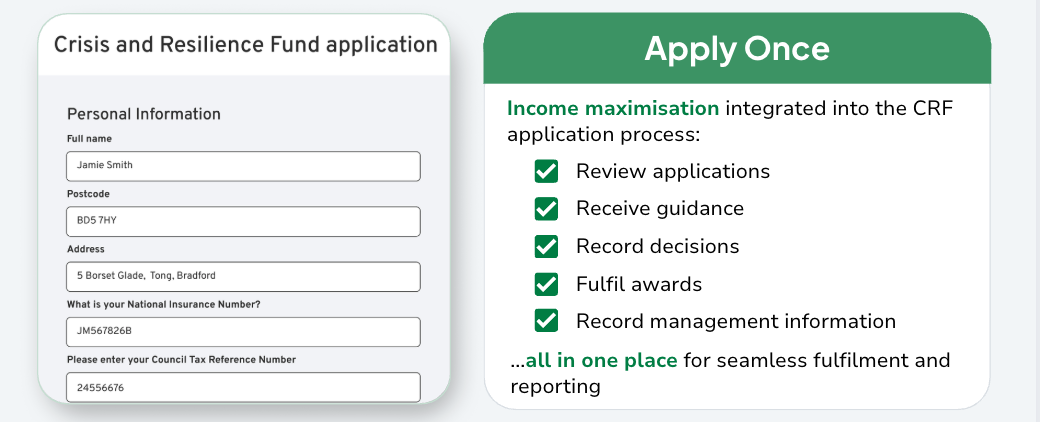
Use the Better Off Calculator's Apply Once to add income maximisation to your CRF process
Principles that must shape delivery
CRF schemes must be person centred, needs based, holistic, trauma informed and based on a “no wrong door” approach.
In practice, this means people should not be turned away because they came through the wrong route, struggled with digital access or were unable to explain their situation clearly. The system should work for people in crisis, not against them.
Authorities must allocate the CRF funding across the following CRF components:
- Crisis Payment: Providing support to those in crisis
- Housing Payment: Providing financial support towards housing needs to those who face a shortfall in meeting their housing costs
- Resilience Services: Funding for services delivered by Authorities or external providers to improve financial resilience
- Community Coordination: Investment in activities that connect and enhance the local support landscape
The CRF is designed to support people facing financial shocks such as disasters, health crises or accidents, domestic abuse, theft, essential household items breaking, and short term income gaps.
The guidance is clear that whether a crisis could have been prevented must not be used to refuse support. Decisions should be based on current need and the risk of harm.
What the fund can pay for
The CRF is deliberately flexible and can cover a wide range of essentials, including food, water, energy, hygiene products, housing costs, clothing, furniture and appliances, transport and digital connectivity. This allows councils to respond to real world need rather than narrow benefit categories.
Housing support can include deposits and moving costs. However, the fund cannot be used for rent arrears, benefit sanctions or overpayment recovery. Where households are placed out of borough, for example families with children in temporary accommodation, discussions should take place between the relevant authorities so support is not blocked by boundaries.
DWP guidance also confirms that councils can use CRF to cover reasonable administration costs, including those delivered by partner organisations, provided these are reported separately through management information returns. This can include staff time, communications and accessibility costs, data and analytics to support targeting, digital and IT systems for referrals and monitoring, and the production of MI reports.
In practice, this allows authorities to invest in tools such as LIFT that support effective targeting, joined up delivery and monitoring of the Crisis and Resilience Fund. Administration spend will be published on GOV.UK alongside overall CRF spending and volumes.
Who decides how the fund is spent
Local authorities decide whether a case is relevant.
The guidance recognises that people in different circumstances, including disabled people, people with substance dependency, people experiencing homelessness, care leavers, single person households, unpaid carers, families with children and pension age households, may have very different short and long term needs.
Support should be based on current hardship and future risk, not whether a crisis could have been prevented.
No Recourse to Public Funds
People with No Recourse to Public Funds are not eligible for crisis support or housing if they are destitute. However, the guidance explicitly encourages flexibility where there are child welfare concerns, caring responsibilities or public health risks. This ensures safeguarding and harm prevention are not overridden by immigration status.
Children and families
Support for children should be targeted to those in need, rather than delivered through blanket schemes such as universal vouchers for all free school meal households. The aim is to focus resources on families experiencing the greatest hardship.
Authorities should also consider how the needs of affected families will continue to be met through the CRF’s Resilience Services and Authorities’ wider local welfare offer. This could include:
- ensuring families eligible for Free School Meals are aware of and can access Resilience Services. Particularly support to ensure families claim all welfare support to which they are entitled
- coordination with the Holiday Activities and Food (HAF) Programme, which supports children from lower income families by providing free meals and enriching activities during school holidays. Authorities can choose to use the CRF funding to supplement or expand HAF provision, where it aligns with the Fund’s outcomes on resilience
- engaging with families at risk of food insecurity by working closely with schools and Family Hubs
- community food aid that promotes the development of new, creative approaches that align with CRF outcomes to build resilient local food landscapes
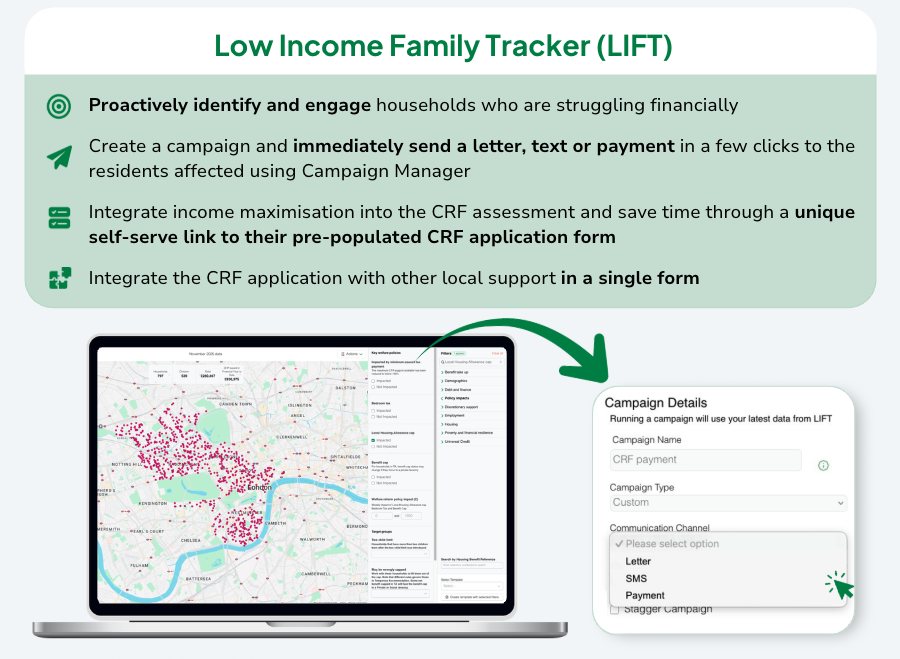
Use LIFT to proactively identify and engage with residents
How CRF schemes should operate
DWP is clear about what good delivery looks like. The fund should be available all year round, with more than one route to apply so it is not online only. It should be clearly advertised and easy to access under CRF branding.
A cash first approach should be used wherever possible, but this must be subject to the individual’s needs and preferences. It must also take account of addiction risks, and of situations where providing goods directly is cheaper or more appropriate, such as supplying white goods rather than cash.
Funding decisions should be needs based rather than first come first served, and support should be paid quickly, ideally within 48 hours, unless in-kind support is being arranged.
The CRF should accept applications and referrals from partners such as Jobcentre Plus, VCSE organisations and food providers, and it should connect people to wider local and national initiatives, including Local Welfare Assistance, Holiday Activities and Food, employment support, debt advice, social work and family hubs. This is how crisis support becomes resilience building.
Data, accountability and outcomes
The CRF is backed by new data and reporting requirements. Local authorities will submit six monthly returns to DWP, and any underspend after three years may have to be returned.
A new data feed will include individual level data on Free School Meals, prescriptions, limited capability for work, children, benefit cap, RSRS, Pension Credit and Housing Benefit. Councils are expected to use this data to understand need, target support and measure impact.
Outcomes to track include changes in savings and debts, use of food parcels, material deprivation, income maximisation, crisis applications and referrals into advice and support services. This is not just about spending money. It is about demonstrating that the system is reducing hardship and future demand.
What good looks like
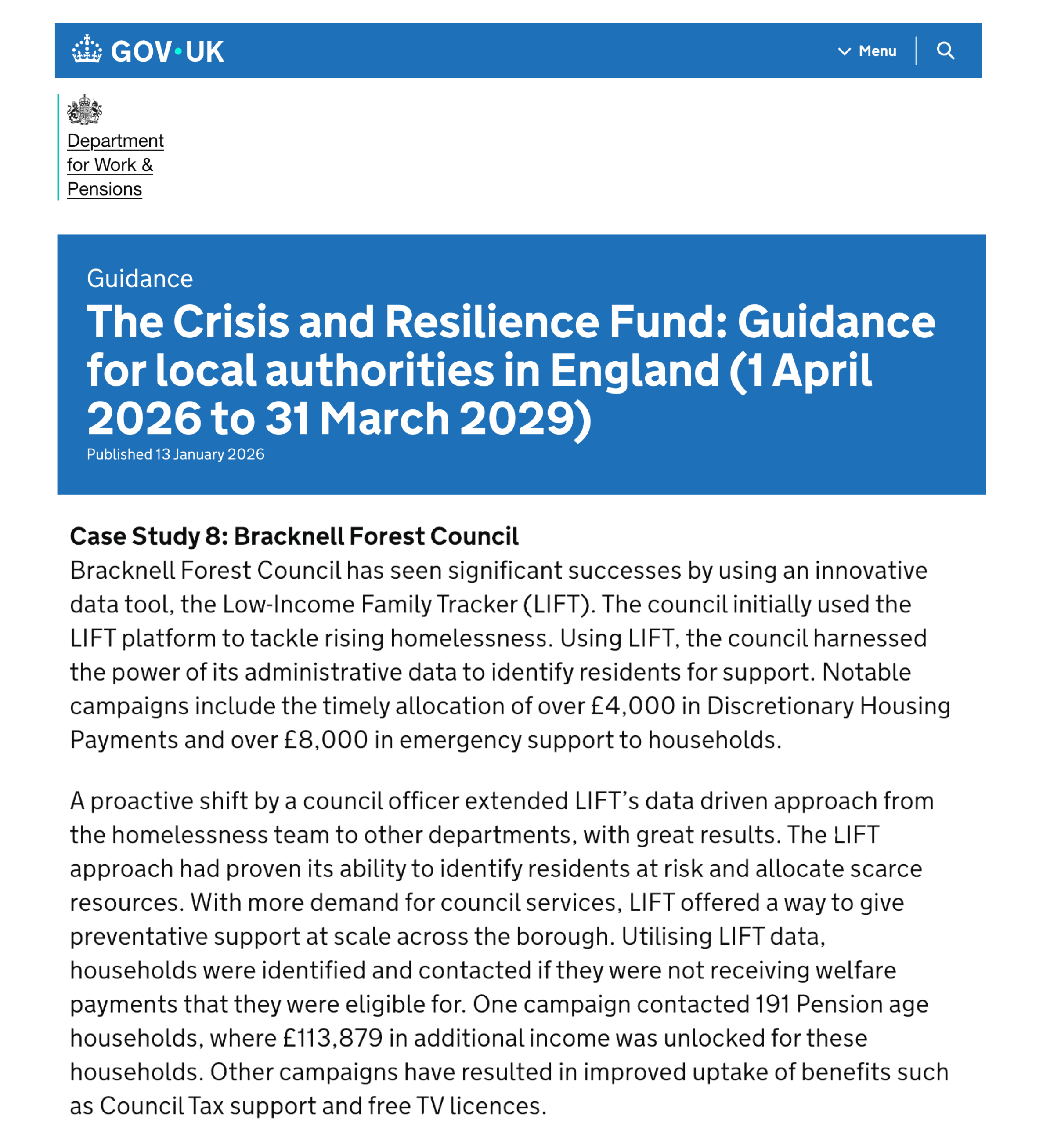
The DWP guidance includes a strong case study from Bracknell Forest Council, showing how data led and proactive use of the CRF can identify and support vulnerable households.
Case studies
- Read Bracknell Forest’s journey from tackling homelessness to benefit take up and arrears recovery using data
- Read From data to doorsteps: How Plymouth allocated discretionary support to families in 2025
- Read Policy in Practice helps councils allocate £18.5 million in Household Support Funds (LGC Awards finalist)
Join our free webinar on Wednesday 21 January to hear about these case studies in more detail
Why this matters: from reactive to proactive
The Crisis and Resilience Fund is one of the most important changes to local welfare in years. Used well, it allows councils to move from responding to today’s emergency to preventing tomorrow’s crisis.
The guidance is clear. The CRF should be used to invest in resilience services, not just emergency payments. That is how councils can reduce hardship, lower repeat demand and give residents a real chance to recover from financial shocks.
Next steps
- Join our free webinar on Wednesday 21 January, CRF: Resetting local crisis support in England. Details and registration here
- Download our Crisis and Resilience Fund cheat sheet here
- Request more Crisis and Resilience Fund case studies here